
How Coffee Degassing Valves Work: The Science of Preserving Freshness
Roasting coffee transforms dense green beans into complex, aromatic products packed with volatile oils and trapped carbon dioxide (CO₂). This gas is both a sign of freshness and a challenge—it continues to escape for days or weeks after roasting, and if not properly managed, it can compromise flavor, shelf life & packaging integrity.
That’s where degassing valves, or one-way coffee valves, come in. These tiny yet critical components maintain the perfect internal environment—releasing built-up CO₂ while preventing oxygen from entering. In other words, they let your coffee breathe without ever exhaling its freshness.
Hawk Flex Packaging designs custom flexible pouches that integrate degassing valves seamlessly, combining performance, sustainability, and brand impact for coffee roasters and beverage brands.
Why Coffee Needs Degassing Valves
When coffee beans roast, internal moisture and organic compounds rapidly convert into gases—mostly carbon dioxide. The result? A single kilogram of roasted coffee can emit up to 2–3 liters of CO₂.
This off-gassing isn’t just a chemistry quirk—it directly affects freshness:
- If trapped, the gas inflates bags and risks bursting seals.
- If vented improperly, oxygen replaces CO₂ and accelerates staling.
- Oxidation breaks down coffee oils, dulling flavor notes and producing bitter, flat tastes.
A properly timed degassing process is crucial. Most roasters rest beans for 12–48 hours post-roast, allowing partial CO₂ escape before packaging. The valve then takes over—releasing the remaining gas in a controlled way to keep pressure balanced and flavor intact.
For brands in the beverage industry seeking more ways to protect aroma & shelf life, explore our Custom Coffee Packaging options for airtight, high-barrier pouches built for freshness.
What Is a Degassing Valve?
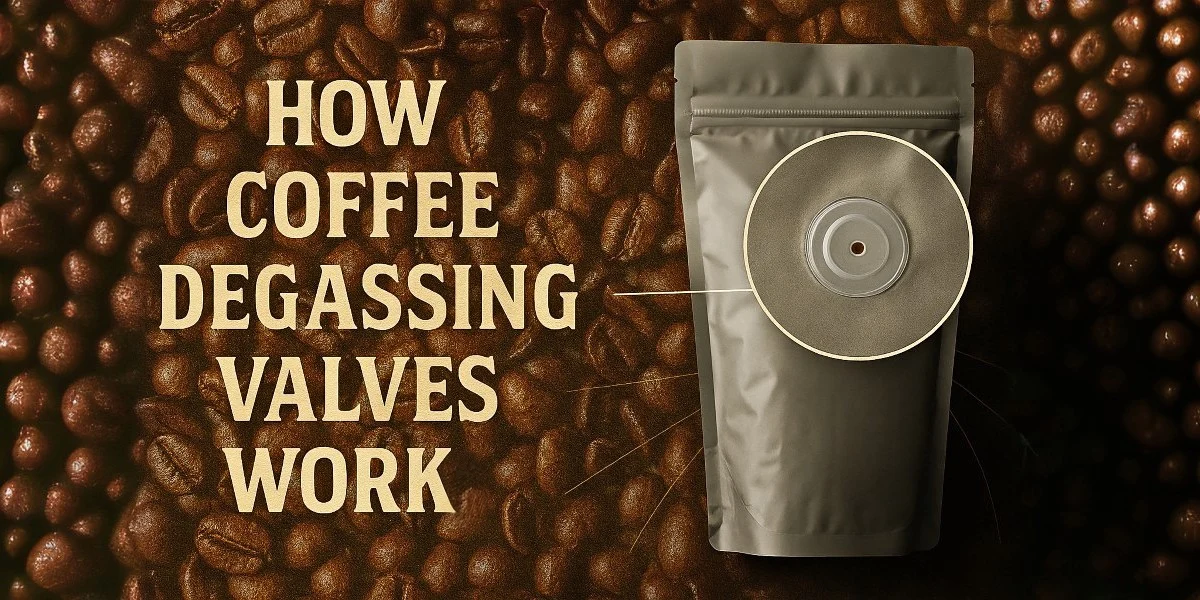
A degassing valve—often called a one-way coffee valve—is a small device engineered to let CO₂ escape while blocking oxygen, moisture & contaminants from re-entering.
Originally patented in the 1960s by Italian firm Goglio, modern valves are precision-molded, lightweight, and built from food-safe plastics or biopolymers. Their effectiveness lies in simple physics: differential pressure.
Each valve typically contains five key parts:
- Cap – Outer housing that seals the mechanism to the pouch wall.
- Elastic Diaphragm – The flexible membrane that opens under internal pressure.
- Viscous Sealant Layer – A microfilm that maintains tension until CO₂ builds.
- Filter Paper Layer – Prevents coffee particles & oils from clogging.
- Base Plate – Stabilizes the entire assembly against the film surface.
When CO₂ pressure inside the bag exceeds atmospheric pressure, it gently lifts the diaphragm, allowing gas to escape. Once the pressure normalizes, the diaphragm reseals instantly—keeping oxygen out.
How Degassing Valves Actually Work
The process sounds simple but is rooted in fluid dynamics and surface tension control.
- CO₂ Accumulates – After roasting, internal gas diffuses from the bean into the package headspace.
- Pressure Builds – As internal pressure surpasses about 3–8 millibars above ambient, it activates the valve.
- Valve Opens – The diaphragm flexes outward, releasing gas through a micro-gap without rupturing the package.
- Valve Reseals – The sealant layer’s viscosity and elasticity pull the membrane back into place once the pressure equalizes.
The result is a micro-ventilation cycle that prevents swelling while maintaining a protective CO₂ cushion around the beans—a proven method to delay oxidation and extend shelf life by up to 60–90 days longer than non-valved packaging.
Valves also safeguard quality during long-haul shipments and altitude changes where atmospheric pressure fluctuates.
Roast Profiles, Density & Degassing Rates
Different roast levels & bean structures release gas at different speeds—critical when choosing valve specs.
- Dark roasts degas rapidly (within hours) due to fractured cell walls.
- Medium roasts offer balanced release, ideal for valve calibration.
- Light roasts hold CO₂ longer because of denser cellular integrity.
Even altitude plays a role. High-elevation beans (dense & hard) release gas slower, requiring longer resting times and lower valve cracking pressures.
Our packaging engineers account for roast density, packaging volume & desired shelf life when selecting valve models. Matching valve sensitivity to roast type ensures optimum freshness with minimal bag expansion.
Placement & Integration in Coffee Pouches
Valve location isn’t aesthetic—it’s functional. Correct placement ensures efficient venting and prevents uneven pressure buildup.
- On stand-up pouches, valves are typically centered 1–2 inches below the top seal.
- On flat-bottom pouches, placement is offset toward the upper face panel for even CO₂ escape.
Automated valve inserters align valves precisely for clean sealing and consistent performance. Proper positioning improves appearance and prevents “ballooning” that can distort graphics or weaken seals.
Sustainable Degassing Valves & Materials
Sustainability is reshaping coffee packaging, and valves are no exception. Traditional petroleum-based valves are being replaced with PLA (polylactic acid) and bio-PE derived from sugarcane.
Modern eco-valves offer:
- Up to 90% less plastic than older versions.
- BPA-free construction & food-grade compliance.
- Compatibility with compostable & recyclable coffee bags.
- Simplified disposal—customers can recycle the bag as a single material.
When combined with recyclable pouch films like mono-PE or kraft + PLA laminates, sustainable valves help brands move toward circular packaging models. This not only cuts waste but also builds customer trust in your environmental responsibility.
See more sustainable material options in our Industry Packaging Solutions section.
Quality Control & Valve Performance Testing
A degassing valve’s reliability depends on how precisely it’s made and tested. Each valve batch undergoes strict verification:
- Cracking Pressure Testing: Confirms consistent activation pressure across units.
- Oxygen Transmission Rate (OTR) Testing: Ensures barrier integrity remains uncompromised.
- Heat-Seal Strength Checks: Verifies adhesion and leak prevention at the insertion point.
- Aging Simulations: Recreates altitude, temperature & humidity changes during global transit.
These quality checks ensure each pouch performs consistently—protecting flavor, aroma & shelf life from roastery to retail shelf.
How Long Coffee Degassing Valves Last
Valves themselves can outlast the coffee’s shelf life. The limiting factor is film degradation, not valve fatigue. In most commercial applications:
- Valve efficiency remains optimal for 6–12 months.
- Beyond that, oxidation risk rises as pouch materials lose elasticity or seal strength.
Controlled storage conditions—cool temperatures & low humidity—extend both packaging and valve lifespan.
Hawk Flex Packaging: Precision Meets Freshness
From valve integration to recyclable film selection, Hawk Flex Packaging delivers complete coffee pouch systems engineered for freshness, branding & sustainability. We specialize in high-barrier laminated structures, custom digital printing & one-way valve installation for both small-batch and large-scale roasters.
Our team works with brands to evaluate degassing rates, select ideal film compositions, and design visually striking packaging that protects quality throughout its journey from roaster to consumer.
Preserving Coffee Freshness with One-Way Valves
Degassing valves aren’t just add-ons—they’re precision-engineered systems that keep roasted coffee at its flavor peak. By letting CO₂ exit while sealing oxygen out, they maintain the delicate balance between pressure control, freshness, and long-term quality.
Modern one-way valves made from bioplastic and recyclable materials now merge performance with sustainability, giving roasters both superior preservation and eco-friendly design. Combined with recyclable pouch films and advanced sealing methods, these innovations allow coffee brands to deliver products that taste and smell as fresh as the day they were roasted.
Smart packaging decisions define the customer’s first impression—and every sip after. When your bag vents properly, your coffee speaks for itself.