
Custom Coffee Packaging
for Roasters
Rotogravure-printed side gusset bags, flat bottom bags and stand-up pouches with one-way degassing valves. Nine colors, true Pantone, no cylinder fees, and the freight and duty already inside the price.
Get a Free Quote
Tell us the roast, the fill weight and the format. We’ll send pricing at several quantity levels.
Trusted by 200+ brands including Kroger, Sprouts, Simple Truth, True Leaf Market, Wild Earth, Miss Jones Baking Co. & Renewal Mill
If You Only Read One Section
What We Are
A California company printing coffee bags by rotogravure at our partner plants in Asia. Nine colors, true Pantone, metallics and opaque white — the things a digital press can’t give you. 5,000 per design minimum.
What It Costs
$0.90 to $1.40 per bag at 5,000, delivered, freight and duty included. Degassing valve $0.04. No plate or cylinder fees — which on a nine-color design saves around $1,350 against suppliers who charge for tooling.
How Long It Takes
8 to 10 weeks from approved artwork, or 4 to 6 expedited. That is door to door: ocean transit is inside the date, not added on top. The clock starts at artwork sign-off, so get proofs moving early. Free samples first, to run on your sealer. Need under 5,000, or bags inside a month? We’ll point you elsewhere.
Coffee Bags We’ve Actually Printed
Side gusset, stand-up and flat bottom, printed for roasters and cold brew brands.
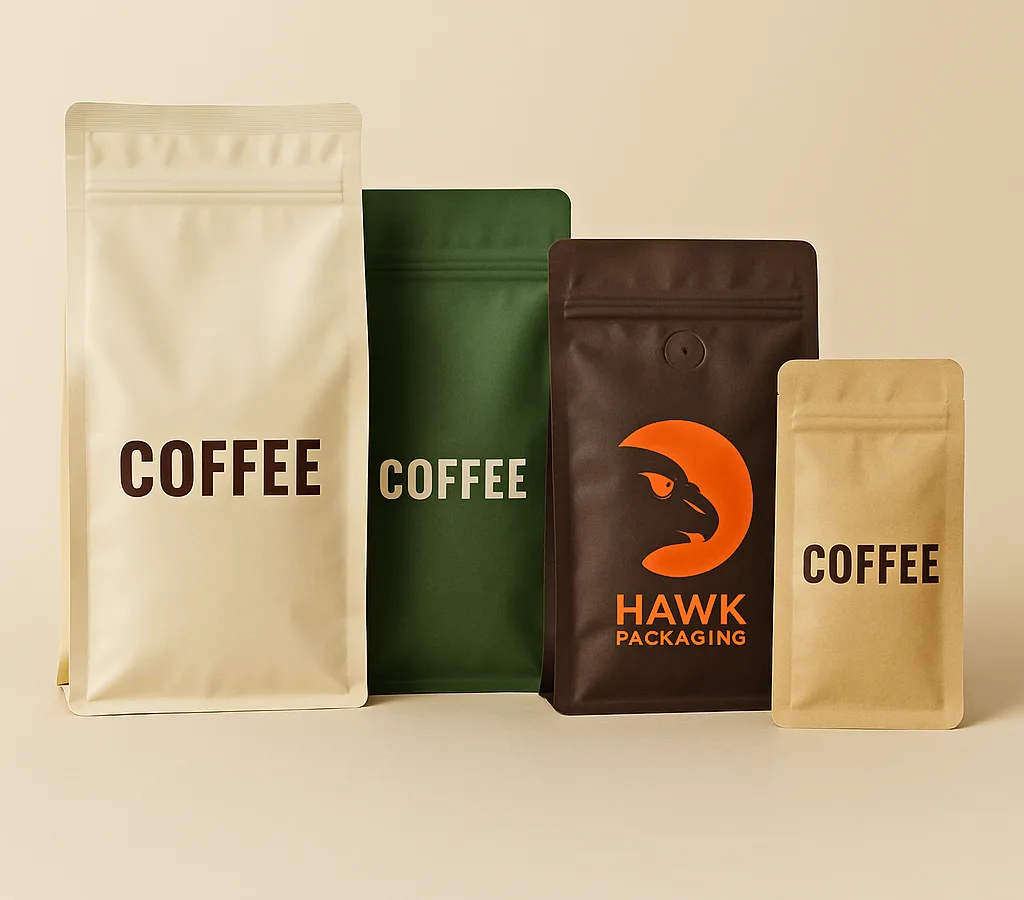
Flat bottom coffee bags
Four sizes off one structure, with a degassing valve fitted to the brown bag. Flat bottom stands square on a shelf and gives you a full front panel to print.
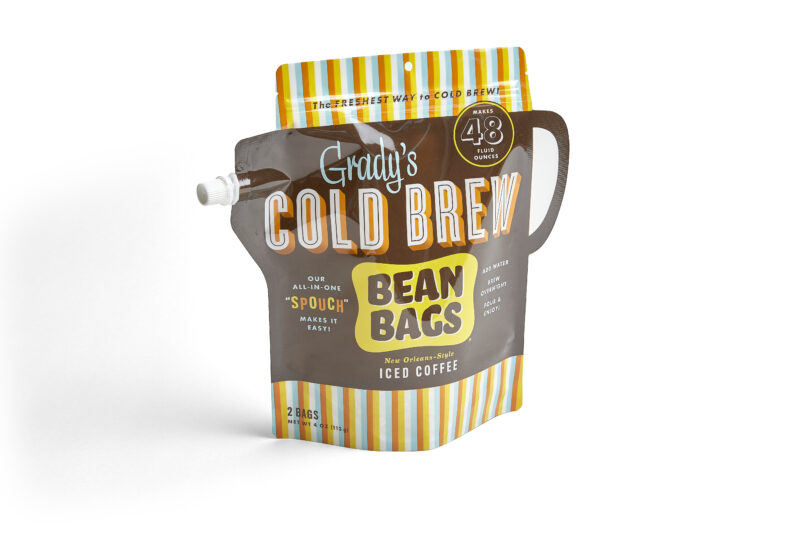
Grady’s Cold Brew
Bean bag packaging for cold brew. A different fill problem to whole bean — and a reminder that one structure doesn’t serve every coffee product.
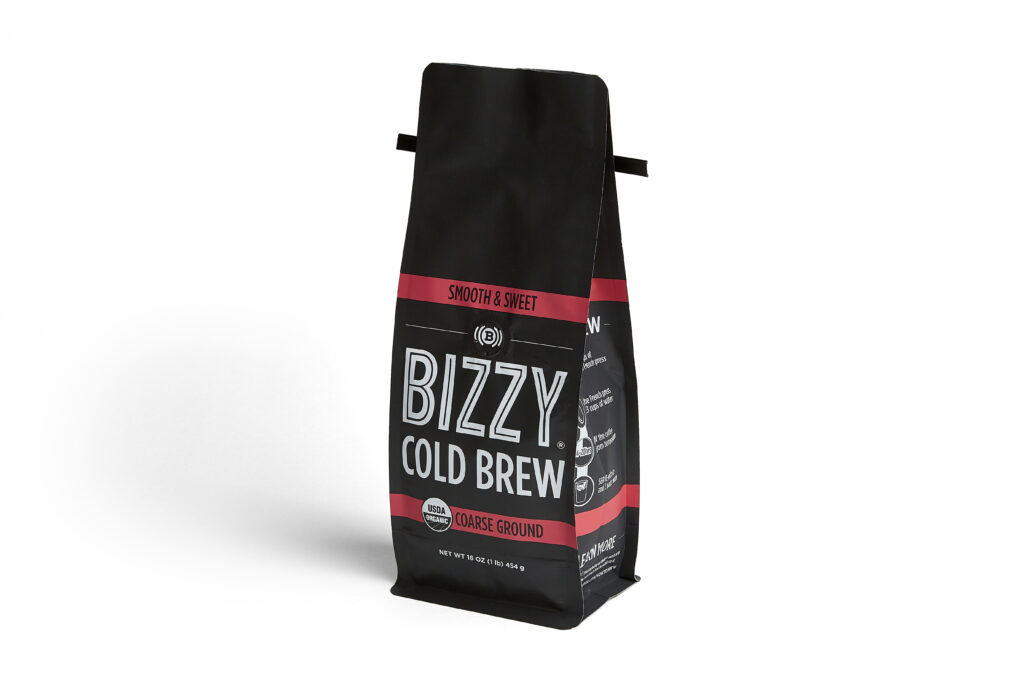
Bizzy Coffee
Stand-up pouches with a resealable zipper for ground cold brew. Heavy ink coverage across the full face, which is where gravure earns its keep.
Grady’s and Bizzy are bags we’ve printed; the flat bottom set is our own sample run. Formats, sizes and finishes shown are examples, not a fixed catalog — dielines are built per job.
Most Coffee Bags Land Between $0.90 and $1.40 at 5,000
Per bag, delivered to your dock, with ocean freight and duty included. Where you land in that range depends on fill weight, structure, finish and format. Pricing drops again at 10,000 and 25,000.
Most suppliers don’t publish prices. Of the ones ranking above us for coffee packaging, one only prices digital printing, one stops at 5,000 units, and one shows no prices at all.
Why no cylinder fees matters here. Gravure needs one engraved cylinder per color, and suppliers who charge for them bill about $150 each — roughly $1,350 on a nine-color bag, before anything is printed. Ours is in the per-bag price, and you are invoiced for what we ship.
Roasted Coffee Is Two Problems at Once
Gas has to get out, and oxygen has to stay out. Those pull in opposite directions, and that is the whole reason a coffee bag is built the way it is.
CO₂ pushing out
Roasting traps carbon dioxide in the bean. Published figures run 5 to 16 mg per gram, which is roughly 2.5 to 8 liters of gas per kilogram of coffee. Seal that in a flexible bag with no route out and the bag inflates, strains its seals, and eventually fails.
Oxygen pushing in
Oxygen drives staling continuously, with no safe plateau. One study measured deterioration accelerating twenty-fold as oxygen partial pressure rose from 0.5 to 21.3 kPa. There is no threshold below which it stops — only slower.
Aromatics simply leaving
Some loss is not oxidation at all. Methanethiol, one of the key fresh-coffee odorants, falls to about 30% of its original level within eight days — and about a third of that decline happens even in a sealed inert reference pack. Volatility, not oxygen.
One myth worth killing: unprotected coffee is not ruined in two weeks. The top notes largely go in one to two weeks, and opened ground coffee hits consumer rejection at 13 to 20 days — but frank rancidity took four months to appear.
What Each Structure Actually Measures
Oxygen transmission rate and moisture vapor transmission rate, with the thickness basis and test conditions stated. Figures are labelled measured or inferred, because the difference matters.
| Structure | Layers | Total | OTR cc/m²·day |
WVTR g/m²·day |
Basis |
|---|---|---|---|---|---|
| PET / aluminum foil / PE The reference barrier |
12 / 8 / 60 µm | 80 µm | <1.0 | — | Measured peer-reviewed, real coffee packs |
| PET / metallized PET / PE The category workhorse |
12 / 12 / 55 µm | 79 µm | <1.5 | — | Measured peer-reviewed, real coffee packs |
| ↳ the same metallized PET as flat film | 12 µm ply alone | — | 0.233 | 0.233 | Measured 23 °C/50% RH · 37.8 °C/90% RH |
| ↳ the same film after lamination | 3-ply laminate | — | 1.5–3.1 4.7 after 270 flexes |
0.31–1.9 | Measured read off published graphs |
| PET / EVOH / PE Great on oxygen, weak on moisture |
12 / 12 / 60 µm | ~84 µm | ≈0.50 20 °C/65% RH |
≈7.4 | Inferred computed from ply data |
| Mono-material PE, metallized Recyclable stream |
38 µm ply | 100–140 µm | 0.93 | 1.09 | Measured component ply |
| Mono-material PE, AlOx-coated | 31.75 µm ply | 100–140 µm | 1.0 30 °C/70% RH |
0.5 40 °C/90% RH |
Measured component ply |
| Mono-material PE, uncoated | 80 µm | — | ~1,270 | — | Inferred not viable for coffee |
| Kraft paper / metallized PET / PE | 65–105 / 12 / 60–80 µm | 140–200 µm | Paper adds no barrier. The metallized or foil ply sets it — use the rows above. | No data published | |
| PLA, compostable sealant | 25 µm | 50–70 µm | ~664 | ~369 | Measured resin datasheet |
The number most coffee bag pages get wrong. Look at the two indented rows: the same metallized PET measures 0.233 as flat film and 1.5 to 3.1 as a finished laminate, rising to 4.7 after 270 flexes. A finished bag performs 5 to 15 times worse than the film datasheet. Ask any supplier whether their figure is the film or the bag.
Ignore the “high barrier” line. You will see 15.5 cc/m²·day quoted as the threshold. No standards body defines it — and every laminate above is 15 to 150 times better, so it tells you nothing about coffee.
Recyclable can hold coffee — there is evidence now. A 2024 peer-reviewed trial held headspace oxygen at 0.3–0.93% across twelve months in a recyclable mono-material polypropylene structure, beating the foil control. Ask us before assuming recyclable means compromised.
Every Coffee Bag We Build Can Take a Valve
$0.04 per bag, placed where you want it.
What it’s actually for
Pressure, not freshness. Roasting leaves 2.5 to 8 liters of CO₂ per kilogram wanting out. A valve lets you seal the day you roast instead of holding coffee in open air while it degasses — which is the part that costs you flavor.
It won’t cost you barrier
A correctly fitted valve admits oxygen at a rate indistinguishable from a sealed control. A badly fitted one doesn’t. So this is an application-quality question, and we treat it as one.
Whole bean needs one
Beans take months to degas and can’t sensibly be sealed without a vent. Ground does most of its degassing in under two weeks, so you could hold it 24 to 48 hours and seal valve-free — paying for that hold in oxidation.
Want the engineering? Measured opening and closing pressures, why a spec sheet only describes a valve’s first opening, why the oil seal rather than the membrane makes it gas-tight, and why coarse grind is the worst case for sizing. How coffee degassing valves work
A “12 oz Bag” Is a Fill Weight, Not a Size
Roast level changes bulk density by nearly half, so a printed ounce rating is a starting point, not a spec.
| Density basis | g/mL | Volume needed for 12 oz (340 g) | vs lightest |
|---|---|---|---|
| Light–medium roast, high end | 0.369 | 922 mL | — |
| Light–medium roast | 0.314 | 1,083 mL | +17% |
| Medium–dark roast | 0.265 | 1,284 mL | +39% |
| Medium–dark roast, low end | 0.250 | 1,361 mL | +48% |
Typical side gusset dimensions
Width × height × gusset, across the suppliers we surveyed. Ranges are real market spread, not tolerance.
| Fill | Dimensions (mm) |
|---|---|
| 8 oz | 79–83 × 260 × 52–60 |
| 12 oz | 86–110 × 290–330 × 59–65 |
| 1 lb | 83–120 × 320–330 × 64–65 |
| 2 lb | 127–140 × 360–381 × 80–89 |
| 5 lb | 133–200 × 432–490 × 90–121 |
Note the 5 lb row. Suppliers disagree by 1.5 to 2× in enclosed volume there. “The” 5 lb coffee bag dimension does not exist.
The market already proves it
One identical 3⅜ × 13 × 2½ inch side gusset body is sold as “11–12 oz”, as “1 lb”, and as “12–16 oz” by different suppliers. A fixed 1,000 mL bag holds 13.0 oz of light roast or 9.3 oz of dark.
A one-pound coffee can has always held 1,000 cc, while its declared weight fell from 16 oz to 10.5. The can never changed.
Watch stand-up pouch capacity ratings
Pouch ounce ratings are set against dense powder — one supplier admits theirs assumes “a fairly dense protein powder” at 0.5–0.6 g/mL, against coffee’s 0.25–0.41. They overstate coffee capacity by 1.3 to 2×.
So we run a fill trial. There is no published volumetric rule for coffee because the practice is to fill a real bag with your actual roast. We start a dieline at roughly 3.3 to 4.6 mL per gram of fill — about 1,130 to 1,570 mL for 12 oz — then the trial confirms it.
Printed by Our Partner Plants in Asia
We would rather you read that here than work it out later.
One delivered price
Ocean freight, duties, handling and the truck to your dock are inside the per-bag number. There is no landed cost to compute afterwards and no surcharge at invoice. If tariffs are what worry you, the honest answer is that they are already priced in, not avoided.
One date, which includes the ocean
8 to 10 weeks from approved artwork, or 4 to 6 expedited. That is the whole timeline, transit included — not a factory lead time with shipping to add on top.
A California company answerable for it
Our office is in Sunnyvale. You deal with us in your time zone, and when something slips we are the ones who fix it rather than forwarding you to a factory.
This is the norm, and it is usually hidden
Two of the three suppliers ranking above us also manufacture in Asia. One discloses it in a privacy policy and on page twelve of a PDF; the other publishes its delays as a Chinese public-holiday calendar and never names the country.
Nothing wrong with sourcing there — it is how gravure at this price exists. You should just be told on the page you are buying from.
When We’re the Right Call, and When We’re Not
We would rather lose a quote than take an order we are the wrong supplier for.
Talk to us
We’re a good fit if
- You’re ordering 5,000 or more per design
- Your artwork needs spot colors, a matched Pantone, metallics or an opaque white
- You’re launching several SKUs at once
- You want one delivered price and one date, not a quote plus freight
- You’re moving from stock bags and labels to printed film
- You need rollstock for a form-fill-seal line
Go elsewhere
We’re the wrong supplier if
- You need fewer than 5,000 of one design — digital printers start at 500
- You need bags inside four weeks
- You change artwork between short runs
- You need a certified home-compostable bag today
- You want to stand on the press floor while your job runs
Rotogravure is a high-volume process. It earns its keep on print quality and unit cost across a long run, and it is genuinely the wrong tool below its minimum. If that is where you are, say so on the phone and we will tell you straight.
What Roasters Ask Us
Minimums, valves, barrier, timing and sourcing.
Want to talk it through?
Tell us the roast, the fill weight and how you’re filling, and we’ll recommend a format, a structure and a valve — and send samples.
What is your minimum order?
5,000 bags per design. Each size and each blend is its own design, so a three-SKU launch is 15,000 bags. Pricing improves at 10,000 and 25,000. If you need less than that, a digital printer is the better answer and we will say so — some start at 500 and a few at 100.
Do you charge plate or cylinder fees?
No. Rotogravure needs one engraved cylinder per color, and suppliers who bill for them commonly charge around $150 per color — roughly $1,350 on a nine-color design. Ours is inside the per-bag price, which is why a multi-SKU launch does not start with a tooling invoice.
How much do custom coffee bags cost?
Most land between $0.90 and $1.40 per bag at 5,000 units, delivered, with ocean freight and duty already inside the number. Where you fall depends on fill weight, structure, finish and format — a 5 lb foil bag is not an 8 oz metallized one. A one-way degassing valve adds $0.04 per bag, and there are no cylinder fees on top. Pricing steps down at 10,000 and 25,000.
How many colors can you print?
Up to nine, by rotogravure. That allows true spot inks, a matched Pantone, metallics and an opaque white alongside process colors. It is the main thing a digital press cannot do — digital printers convert spot colors to CMYK and will not guarantee a Pantone match, and they generally offer no metallic ink and no spot varnish.
What does the degassing valve cost, and do I need one?
$0.04 per bag. For whole bean in a flexible bag, yes — beans take months to degas and there is no sensible way to seal them without a vent. For ground coffee you could hold it in open air for 24 to 48 hours and seal valve-free, but you pay for that hold in oxidation, which is the thing the valve exists to avoid.
Does fitting a valve hurt the bag’s barrier?
Not by design. In controlled testing an oiled valve admitted 0.37 to 0.44% oxygen — indistinguishable from the test rig’s own leak rate. The same valve unoiled admitted 1.02 to 1.94%, and a bare hole reached full atmosphere. The oil makes the seal, not the membrane, so the real risk is application quality.
Which structure should I use?
For most roasters, PET / metallized PET / PE — measured under 1.5 cc/m²·day on real coffee packs. Use PET / foil / PE for the lowest oxygen ingress, accepting that thin foil loses barrier to creasing. Avoid EVOH for coffee: strong on oxygen, 10 to 30 times poorer on moisture, and it degrades above 75% RH.
Can I get a recyclable or compostable coffee bag?
Recyclable, yes — a 2024 peer-reviewed trial held headspace oxygen at 0.3 to 0.93% for twelve months in a recyclable mono-material structure, beating the foil control. Compostable is harder and we won’t oversell it: PLA alone is roughly a thousand times more oxygen-permeable than a metallized laminate, so it depends entirely on a coated barrier ply.
How long will my coffee stay fresh in the bag?
No single number, because the research doesn’t support one per bag type. What it shows: nitrogen-flushed ground coffee at 2 to 3% residual oxygen stayed acceptable six months or more at 25 °C, against three unflushed. Note the “below 2%” figure quoted as an SCA standard is not one — SCA publishes no such spec, and its own handbook says oxidation continues below 2%.
What size bag do I need for 12 oz?
It depends on the roast, by more than you’d expect. 12 oz of light-medium roast needs about 922 mL; the same weight of dark roast needs up to 1,361 mL — 48% more. One bag body is sold across the market as “11–12 oz”, “1 lb” and “12–16 oz”. We start at 3.3 to 4.6 mL per gram, then run a fill trial.
Where are the bags actually printed?
By our partner plants in Asia. We are a California company and we carry the whole job including ocean freight and customs, so you get one delivered price and one date rather than a factory quote plus shipping to work out. Two of the three suppliers ranking above us for coffee packaging manufacture in Asia too — they just do not say so on the page.
How fast can I get bags, and when does the clock start?
8 to 10 weeks from approved artwork, or 4 to 6 expedited, transit included. The clock starts at artwork approval, not at the order — which is true of every supplier in this category, though not all of them say it. Get the dieline and proofs moving early and the lead time behaves.
Can I see a bag before I commit?
Yes. We send samples free, and we would rather you filled one and ran it on your sealer before placing 5,000. Worth knowing: one of the suppliers ranking above us states plainly that it cannot provide samples of your fully customized bag at all.