
Packaging Granola: How Long Will It Store?
Packaged granola typically keeps six to twelve months in a high-barrier pouch, and longer with a nitrogen flush or an oxygen absorber. The bag matters more than anything else: in published testing, identical granola ranged from 33 days to 271 days depending only on the film. What ends shelf life is moisture softening the crunch and oxygen turning the oils in the oats and nuts — not spoilage.
Table of Contents
- How Long Packaged Granola Actually Lasts
- Granola Does Not Spoil. It Goes Soft, Then It Goes Rancid.
- The Crispness Cliff
- Why Oats Are the Awkward Cereal
- What the Film Has to Do
- The Dried Fruit Is a Moisture Reservoir Inside Your Own Bag
- Oxygen Absorbers and Nitrogen Flushing
- Storing Finished Pouches Before They Ship
- What to Actually Specify
- Granola Packaging FAQ
How Long Packaged Granola Actually Lasts
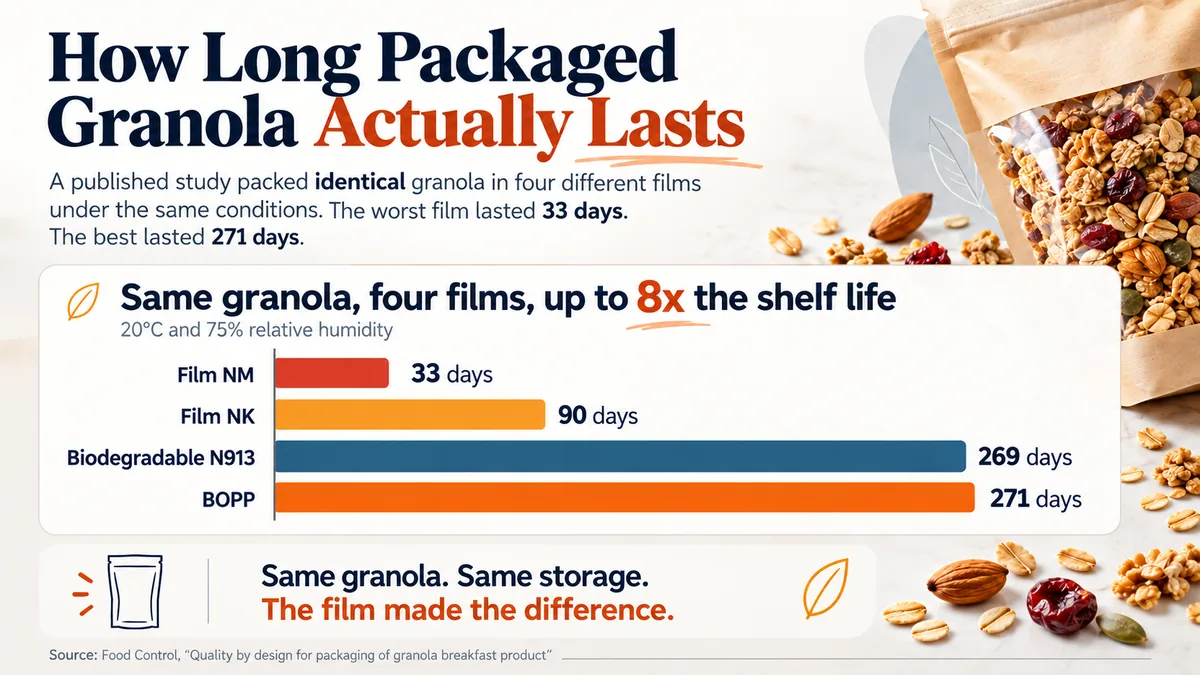
The honest answer is that it depends almost entirely on the bag, and the difference is larger than most brands expect. A published study packed identical granola in four different films and stored it under the same conditions. The worst film gave 33 days. The best gave 271.
As a working guide for what the common formats deliver:
| Packaging | Typical shelf life | What limits it |
|---|---|---|
| Unlined paper bag | Weeks | Almost no moisture barrier |
| Standard clear film pouch | A few months | Moisture pickup softens it first |
| High-barrier pouch (metallized or foil) | Six to twelve months | Slow oxygen ingress through film and seals |
| High-barrier pouch plus nitrogen flush or absorber | Twelve months and beyond | Residual oxygen and storage temperature |
One thing worth saying plainly for anyone who arrived here holding a bag at home: a best-before date is a quality date, not a safety one. USDA guidance is explicit that product dating indicates when food is at its best, not when it becomes unsafe. Granola that has gone soft or tastes flat is stale, not dangerous.
Granola Does Not Spoil. It Goes Soft, Then It Goes Rancid.
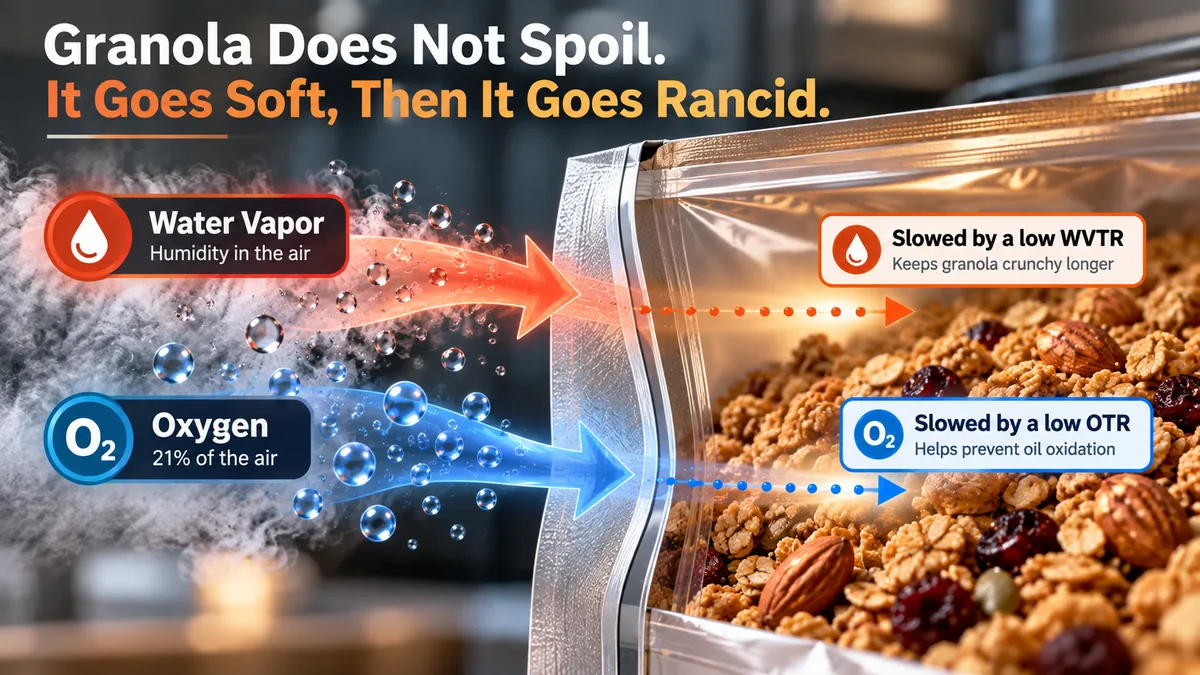
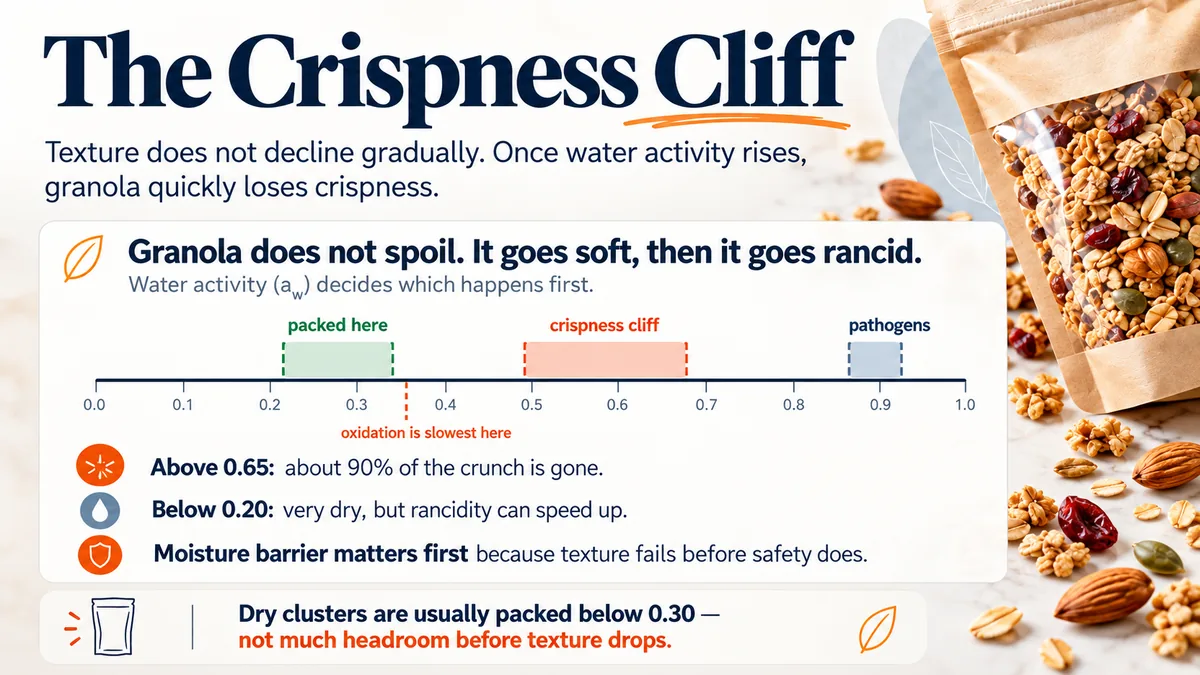
This is the part most packaging articles get wrong, and it changes every decision downstream. Granola is a low-moisture food. At the water activity it is normally packed at, it sits far below the level any micro-organism needs — bacteria need about 0.91, most yeasts around 0.88, and even the most tolerant molds stop below roughly 0.60. The FDA treats 0.85 as the line for pathogen growth.
So granola has no microbial shelf-life problem. It has a chemical and physical one, and both are packaging problems.
The Crispness Cliff
Texture does not decline gently as moisture creeps in — it falls off a cliff. Published work on breakfast cereals puts the critical water activity near 0.5, with roughly 90% of crispness lost between aw 0.47 and 0.65, and brittleness gone entirely by 0.8. Absorbed water plasticizes the matrix and drops its glass transition temperature below room temperature: glassy becomes rubbery, and crunch becomes chew.
There is a counterintuitive second point on the water activity scale. Drier is not always better. Lipid oxidation passes through a minimum around aw 0.35 and speeds up again below it: a monolayer of bound water physically shields reactive sites and hydrates the trace metals that catalyze oxidation. Strip it out and you expose them. Over-drying below about 0.20 buys texture insurance at the cost of faster rancidity.
The practical consequence is that moisture barrier is the first spec to get right, because texture fails before flavor does.
Why Oats Are the Awkward Cereal
Oats carry about 7% lipid, and some varieties considerably more, against roughly 1–3% for wheat, barley and rye. That alone makes granola fattier than its ingredient list suggests. Two further facts make it worse:
- The oil is in the endosperm, not the germ. Around 86–90% of an oat’s oil sits in the starchy endosperm, unlike other cereals. You cannot degerm the fat out of an oat, and flaking exposes it directly.
- Oat lipase is 10–15 times more active than wheat’s. Left alone it hydrolyses fats into free fatty acids — which is the substrate oxidation then attacks.
This is why oats are kilned before they reach you. Steam treatment around 90°C followed by drying inactivates the enzyme, and it needs moist heat rather than dry heat to work properly. One published trial found 20 minutes of steaming roughly doubled shelf life, from 28 days to 56.
That matters for packaging because it tells you what is left. Kilning handles the enzymatic route before the product is packed. Everything remaining — oxidation driven by oxygen, heat and light — is controlled by the bag. When it fails you get hexanal, the compound behind the cardboard note, perceptible in ready-to-eat oat cereals at roughly 5–10 ppm.
What the Film Has to Do
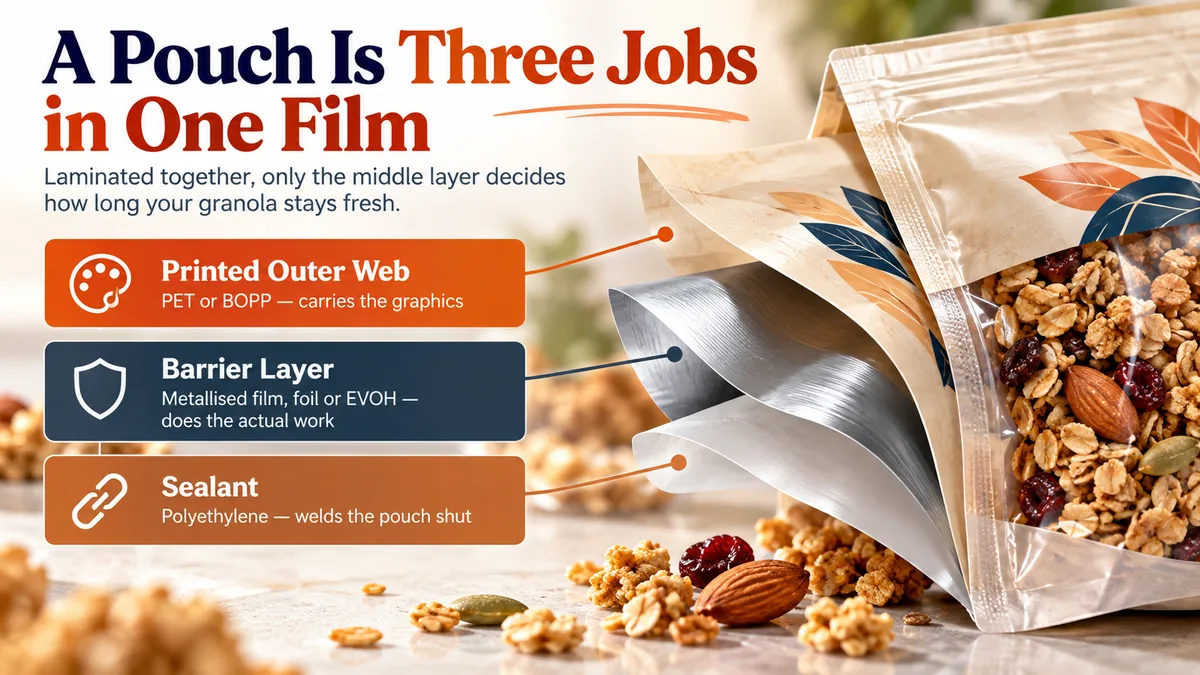
For a low-moisture, high-fat product the barrier has three jobs, in this order:
- Moisture barrier — protects texture, which fails first.
- Oxygen barrier — protects flavor, and matters more as fat and nut content rise.
- Light barrier — not cosmetic. Riboflavin in cereal is light-sensitive and acts as a photosensitiser, generating singlet oxygen that attacks unsaturated fats by a considerably faster route than ordinary oxidation. That is the real argument against a full clear window on a nut-heavy granola under retail lighting.
Cereal targets are commonly quoted around WVTR 1–3 g/m²/day and OTR 1–10 cc/m²/day. Treat those as a starting point rather than a standard — they are supplier conventions, and a transmission rate quoted without its test temperature and humidity does not mean much. Ask for the conditions.
And do not overlook the seal. A film specified to a tenth of a gram per square meter is undone by a channel in a seal, which is a far more common failure than the film itself.
The Dried Fruit Is a Moisture Reservoir Inside Your Own Bag
This is the one nobody mentions, and it is the most practical thing on this page. Dried fruit is typically dried only to around aw 0.5. Your oat clusters sit nearer 0.2. Seal them together and water moves from the fruit into the oats until they equalize — the headspace reaches equilibrium within about a minute, and transfer between the pieces plays out over months.
The damage runs both ways: the fruit toughens while the clusters soften.
Barrier film cannot fix this. The film controls what comes in from outside; it does nothing about equilibration inside the pack. That half is a recipe problem — infused or coated fruit, water-activity-matched inclusions, or keeping components separate. Any supplier implying a better bag solves it is selling you something.
Oxygen Absorbers and Nitrogen Flushing
Both reduce oxygen in the pack, by different routes. An absorber scavenges what is already there and can reach very low residual levels. Nitrogen flushing displaces oxygen at the moment of filling, is faster on a high-speed line, and typically lands under 1%.
Three honest caveats before you buy either:
- Neither does anything about moisture — and in the published granola work, moisture was the controlling variable. Oxygen scavenging behind a poor moisture barrier will not save the crunch.
- Either is only as good as the film and the seal. A low-oxygen headspace re-equilibrates through a leaky pack.
- Because oxidation speeds up again below the monolayer, aggressive oxygen removal combined with a very low water activity is not simply additive protection.
Storing Finished Pouches Before They Ship
Shelf life is measured from production, not from the day the pouch reaches a shelf, and warehouse conditions spend that budget faster than anything else. Keep finished stock cool and dry, because heat accelerates every oxidation reaction described above. Keep handling down, since punctures and seal damage in transit undo the barrier you paid for. And rotate properly — the oldest pallet ships first.
What to Actually Specify
Granola fails in two ways and both are packaging decisions. Moisture gets in and the crunch goes. Oxygen gets in and the oils turn. If you are writing a spec: lead with the moisture barrier, size the oxygen barrier to your fat and nut content, block the light if the recipe is nut-heavy, insist on test conditions with every transmission rate you are quoted, and solve the dried fruit in the recipe rather than hoping the film will cover it.
Get those right and the granola on the shelf tastes like the granola that left your line. If you want a second opinion on a structure, our flexible barrier packaging guide covers how the materials compare, and we quote custom granola packaging from 5,000 bags per design.
Granola Packaging FAQ
How long does commercially packaged granola last?
Six to twelve months in a high-barrier pouch is typical, and beyond twelve months with a nitrogen flush or an oxygen absorber. Film choice matters more than anything else: in published testing, identical granola ranged from 33 days to 271 days depending only on the film.
What water activity does granola need to stay crisp?
Dry clusters are normally packed below a water activity of 0.30. About 90% of crispness is lost between 0.47 and 0.65, so there is only around 0.2 units of headroom. Going below about 0.20 is counterproductive, because lipid oxidation speeds up again at very low moisture.
Why does granola go rancid before it goes stale?
Because oats are unusually fatty for a cereal, at about 7% lipid against 1 to 3% for wheat, and most of that oil sits in the endosperm where flaking exposes it. Once oxygen reaches those fats they oxidize, producing hexanal, perceptible in oat cereals at roughly 5 to 10 ppm.
Does the dried fruit make granola go soft faster?
Yes. Dried fruit is usually dried only to a water activity around 0.5 while oat clusters sit near 0.2, so moisture migrates from the fruit into the clusters until they equalize. Barrier film cannot prevent this, because it happens inside the sealed pack; it has to be handled in the recipe.